
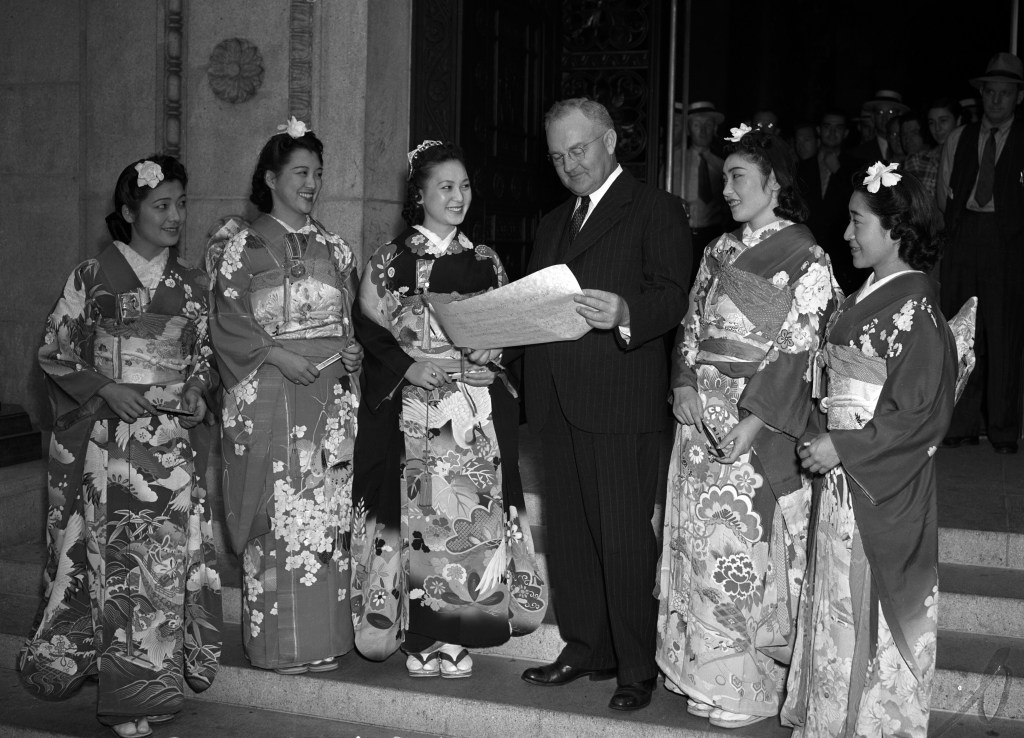
Season 7, Episode 4-“Nisei Women in Japanese Internment” with Grace McCord

Nisei Week beauty competion

Junior history minor Grace McCord joins Hollie to discuss Nisei Women in Japanese Internnment camps in the US during WWII. Second-generation Japanease -American women, or Nisei women, faced significant challenges during WWII in Japanese Internment camps, but their experiences also foreced a shift in the structure of their families, allowing them some measure of independence from traditional expectations. Through education, vocational training, and military volunteer opportunities, Nisei women displayed agency and resilence.

You can find this episode on Apple Podcasts, SpotifyAmazon Music, or any of the major podcast platforms. Make sure to subscribe so you never miss an episode. While you’re there, give us a review. Let us know what you like and share widely!

Selected Bibliography:

Ito, Leslie. “Japanese American Women and the Student Relocation Movement, 1942-1945.” Frontiers: A Journal of Women Studies 21, no. 3 (2000): 1–24. https://doi.org/10.2307/3347107.

Kurose, Akiko. “Akiko Kurose Interview I.” Interview by Matt Emery, Densho, July 17, 1997. https://ddr.densho.org/media/ddr-densho-1000/ddr-densho-1000-41-transcript-3d1725e567.htm.

Sakahara, Toru and Sakahara, Kiyo. “Toru Sakahara – Kiyo Sakahara Interview I.” Interview by Dee Goto. Densho, Feburary 24, 2024. https://ddr.densho.org/media/ddr-densho-1000/ddr-densho-1000-76-transcript-cd0479f05b.htm.

Suzuki Ichino, Mary. “Mary Suzuki Ichino Interview.” Interview by Richard Potashin. Densho, July 17, 2008. https://ddr.densho.org/media/ddr-manz-1/ddr-manz-1-51-transcript-b6b177d9c1.htm.

Are you interested in a history degree? We have online and on campus B.A. programs and we also have online and on campus M.A. programs in history or public history. Learn more at https://www.fhsu.edu/history/academic-program

Season 7, Episode 3 “Lizzie Borden- Gender and Religion at the Trial” with Riley Kershner

Lizzie Borden

“Lizzie Borden took an ax. Gave her mother forty whacks. When she saw what she had done, she gave her father forty one.”

Sophomore History Education Major Riley Kershner joins Hollie to talk about the infamous trial of Lizzie Borden and the role that gender and religous biases played in the investigation, trial, and media coverage.

Also Lizzie Borden

Hollie depicted Lizzie Borden with her ax on Riley’s rough draft of the paper and Riley incorporated it into her final presentation. It is clear based on this drawing why Hollie is a historian, not an artist.

You can find this episode on Apple Podcasts, SpotifyAmazon Music, or any of the major podcast platforms. Make sure to subscribe so you never miss an episode. While you’re there, give us a review. Let us know what you like and share widely!

Selected Bibliography:

Inquest Testimony of Lizzie Borden, August 9-11, 1892. Fall River Court Building. https://famous-trials.com/lizzieborden/1444-inquest.

Bartle, Ronald. Lizzie Borden and the Massachusetts Axe Murders. Waterside Press, 2017.

Porter, Edwin H. The Fall River Tragedy: A History of the Borden Murders. Press of J.D. Monroe, 2018.

Are you interested in a history degree? We have online and on campus B.A. programs and we also have online and on campus M.A. programs in history or public history. Learn more at https://www.fhsu.edu/history/academic-program

S2, Episode 4-“Women’s Roles in Food Preparation in the Holodomor” with Alissa Zajac

Season 2 Episode 4

Memorial ‘the Holodomor’; 1932-1933 (death by hunger) in Kyiv, Ukraine” by Andrew J.Swan is licensed under CC BY-NC-ND 2.0.

In the years 1932-1933, Ukraine suffered a famine that historians estimate killed over four million Ukrainians. As a result of the famine, women had to come up with different survival strategies and methods for procuring and preparing food for themselves and their families. Senior history major Alissa Zajac joins Hollie Marquess to discuss women’s roles in food procurement and preparation during the Holodomor.

You can find this episode on Apple Podcasts, SpotifyAmazon Music, or any of the major podcast platforms. Make sure to subscribe so you never miss an episode.

Selected Bibliography:

Bohdan Klid, and Alexander J. Motyl. The Holodomor Reader: A Sourcebook on the Famine of 1932-1933 in Ukraine. Toronto: CIUS Press, 2012.

Borysenko, Valentyna. A Candle in Remembrance: An Oral History of the Ukrainian Genocide of 1932-1933. New York: Ukrainian Nation Women’s League of America, 2010.

Applebaum, Anne. Red Famine: Stalin’s War on Ukraine. New York: Doubleday, 2017.

Kis, Oksana. “Defying Death: Women’s Experience of the Holodomor, 1932-1933.” Aspasia 7, no. 1 (January 1, 2013).

Kis, Oksana. “Women’s Experience of the Holodomor: Challenges and Ambiguities of Motherhood.” Journal of Genocide Research 23, no. 4 (October 2, 2021): 527–46.