
Season 7, Episode 2 “Manhood in a Bottle” with Larry Zieammermann

In episode 2 of this season, history graduate student Larry Zieammermann joins Hollie to talk about the intersection of baldness, patent medicines, and masculinity. We’ve covered patent medicines on this podcast before. If you haven’t already, make sure to listen to season 2, episode 7 “Patent Medicines in the West” with Erin Adams, which is one of Hollie’s all time favorite episodes.

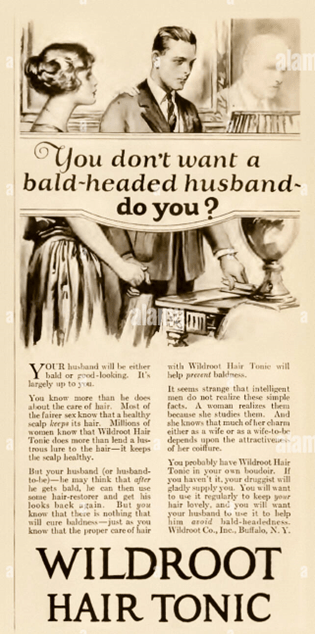
Larry’s research focues on male balding in the 19th and early 20th centuries. He includes a discussion of this advertisement for Wildroot Hair Tonic from 1924:
You can find this episode on Apple Podcasts, SpotifyAmazon Music, or any of the major podcast platforms. Make sure to subscribe so you never miss an episode. While you’re there, give us a review. Let us know what you like and share widely!

Selected Bibliography:

Johnes, Martin. “Masculinity, Modernity and Male Baldness, c.1880‐1939.” Gender & History 35, no. 1 (2023): 190–211.

Wildroot Hair Tonic, Wilroot, Co., Inc. “When love is young-why worry about hair?.” Advertisement. 1924. https://archive.org/details/WildrootHairTonic1924A.

Young, James Harvey. The Toadstool Millionaires: A Social History of Patent Medicines inAmerica before Federal Regulation. Princeton University Press, 2015.

Are you interested in a history degree? We have online and on campus B.A. programs and we also have online and on campus M.A. programs in history or public history. Learn more at https://www.fhsu.edu/history/academic-program
S6, E5-“Resistance to Cannabis Prohibition, 1930-1945” with Dr. Emory Wilder

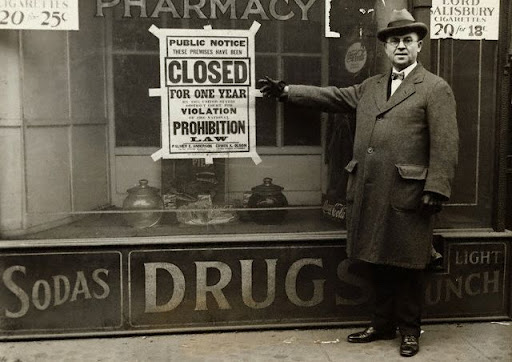
In episode 5, Dr. Emory Wilder, FHSU Masters student joins Hollie to discuss “Serpents” and “Vipers” and the resistance to cannabis prohibition from 1930-1945. Dr. Wilder covers cannabis in patent medicines, cannabis as a muse in jazz music, and the circumstances that led to discourse on a federal ban.

You can find this episode on Apple Podcasts, SpotifyAmazon Music, or any of the major podcast platforms. Make sure to subscribe so you never miss an episode. While you’re there, give us a review. Let us know what you like and share widely!

Selected Bibliography:

Anslinger, Harry J. “Marijuana, Assassin of Youth.” Reader’s Digest (1938).
https://www.druglibrary.org/schaffer/history/e1930/mjassassinrd.htm.

Chasteen, John Charles. Getting High: Marijuana in World History. Lanham: Rowman and Littlefield, 2022. ProQuest Ebook Central.

Cohen, Michael M. “Jim Crow’s Drug War: Race, Coca Cola, and the Southern Origins of Drug Prohibition.” Southern Cultures 12, no. 3 (Fall 2006): 55-79.
https://www.jstor.org/stable/26391000.

Smith, Stuff, and the Onyx Club Boys. “If You’re a Viper.” March 13, 1936. Audio
recording. 00:03:20. hTps://soundcloud.com/stella-blue-1/youre-a-viper-stuff-smith-and.

Webb, Chick, and His Orchestra. “When I Get Low I Get High.” April 7, 1936. Audio recording. 00:02:29. https://archive.org/details/JV-10685-1936-
Qmepcnc4nyXcKRPmrZTHeJGTKJ9GTuBdXVxd7JbqxZMi3e.mp3.

Are you interested in a history degree? We have online and on campus B.A. programs and we also have online and on campus M.A. programs in history or public history. Learn more at https://www.fhsu.edu/history/academic-program
S2- Episode 7 “Patent Medicines in the West” with Erin Adams

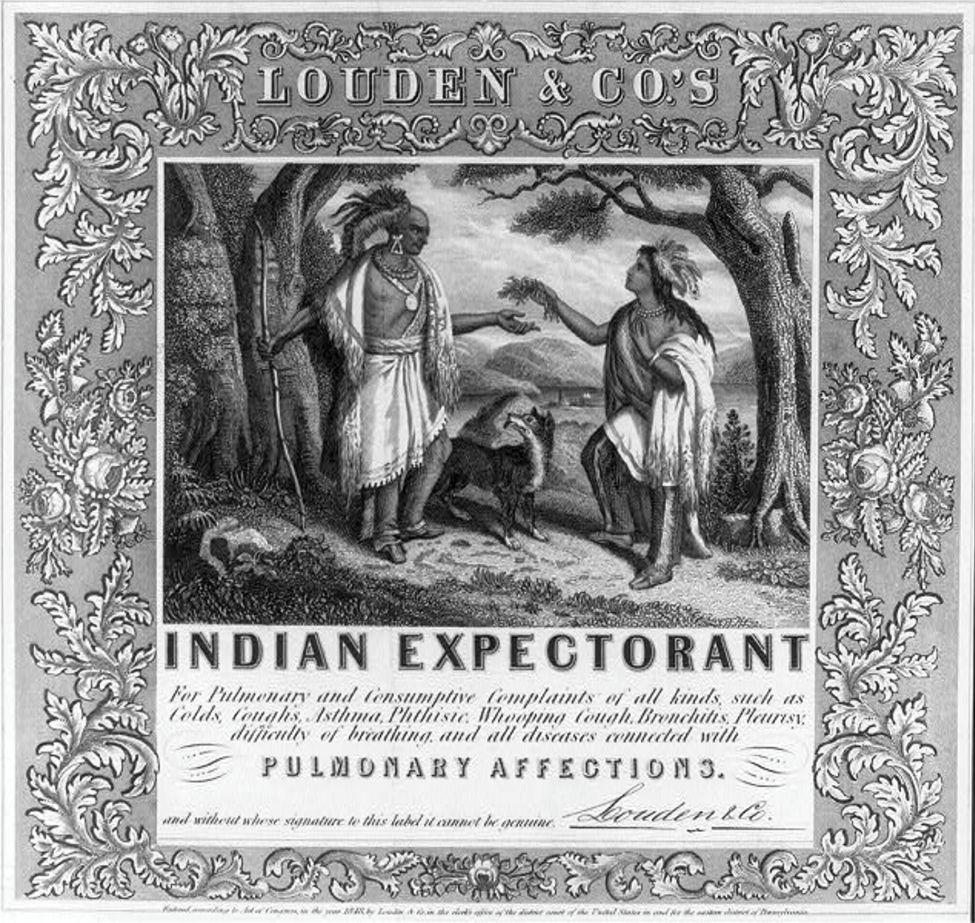
In this episode, graduate student Erin Adams joins Hollie Marquess to discuss the sale of patent medicines in the west and how they used Native American imagery to sell their potions. They also discuss how the Great British Bake Off relates to Turner’s theory of the West. 

You can find this episode on Apple Podcasts, SpotifyAmazon Music, or any of the major podcast platforms. Make sure to subscribe so you never miss an episode.

Selected Bibliography:

Primary Sources:

Adams, Samuel Hopkins. “If It’s Medical, It’s a Swindle.” New York Tribune. January 6, 1915, 74 edition, sec. 24,888. https://chroniclingamerica.loc.gov/lccn/sn83030214/1915-01-06/ed-1/seq-1/.

Louden’s Indian Expectorant. , ca. 1848. Photograph.

https://www.loc.gov/item/2001701409/.

Glackens, L. M. , Artist. The Indian Medicine Show / L.M. Glackens. N.Y.: Published by Keppler & Schwarzmann, Puck Building, November 2. Photograph. Retrieved from the Library of Congress, <www.loc.gov/item/2011647635/>.

“Kickapoo Indian Sagwa: Blood, Liver, Stomach and Kidney Renovator.” National Museum of American History. Accessed 2020. https://americanhistory.si.edu/collections/search/object/nmah_1296185.

Secondary Sources:

Burns, Stanley B., and Elizabeth A. Burns. “Wizard Oil patent medicine salesmen. (A Pictorial History of Healing).” Clinician Reviews, July 2002, 43. Gale Academic OneFile (accessed Spring, 2020). https://link.gale.com/apps/doc/A90248517/AONE?u=klnb_fhsuniv&sid=AONE&xid=e7f78c7c

Biron, Gerry. “Haudenosaunee (Iroquois) participation in 19th century medicine shows.” Whispering Wind, August-September 2013, 6+. Gale Academic OneFile. https://link-gale-com.ezproxy.fhsu.edu/apps/doc/A347521927/AONE?u=klnb_fhsuniv&sid=AONE&xid=8dfc0ca3.

Rosenberg, John. 2012. “Barbarian Virtues in a Bottle: Patent Indian Medicines and the Commodification of Primitivism in the United States, 1870-1900.” Gender & History 24 (2): 368–88. doi:10.1111/j.1468-0424.2012.01687.x.

Are you interested in a history degree? We have online and on campus B.A. programs and we also have online and on campus M.A. programs in history or public history. Learn more at https://www.fhsu.edu/history/academic-programs/