S5, E8- “The Orphan Train” with Joanna Lockwood

In the last episode of the season, Joanna Lockwood, History Masters Student at FHSU, joins Hollie Marquess to discuss the orphan train. Joanna explains how and why the orphan train began, the experiences faced by orphan train riders on their journey and in their new homes, and modern memorialization efforts. Joanna’s great-grandfather, George Lockwood, was an orphan train rider at just six years old.

You can find this episode on Apple Podcasts, SpotifyAmazon Music, or any of the major podcast platforms. Make sure to subscribe so you never miss an episode. While you’re there, give us a review. Let us know what you like and share widely!

Selected Bibliography:

Primary Sources

Johnson, Mary Ellen. Orphan Train Riders: Their Own Stories. Vol. 1. Wever, IA: Quixote Press, 1992. (This is just the first of a six-volume collection compiled by Mary Ellen Johnson and the OTHSA organization).

Secondary Sources

The American Experience: The Orphan Trains. Produced and Directed by Janet Graham and Edward Gray. Crystal City, VA: PBS, 1995. https://www.pbs.org/wgbh/americanexperience/films/orphan/#cast_and_crew.

Aviles, Donna Nordmark. Orphan Train to Kansas. Shelbyville, KY: Wasteland Press, 2018

Holt, Marilyn Irvin. The Orphan Trains: Placing Out in America. Lincoln, NE: University of Nebraska Press, 1992.

Kidder, Clark. Emily’s Story: The Brave Journey of an Orphan Train Rider. Self-published, CreateSpace Publishing, 2007.

Langsam, Miriam Z. Children West: A History of the Placing-Out System of the New York Children’s Aid Society, 1853-1890. Madison: State Historical Society of Wisconsin for Department of History, University of Wisconsin, 1964.

Are you interested in a history degree? We have online and on campus B.A. programs and we also have online and on campus M.A. programs in history or public history. Learn more at https://www.fhsu.edu/history/academic-program
S5, E7- “The Nazi Olympics” with Keith Kuehn

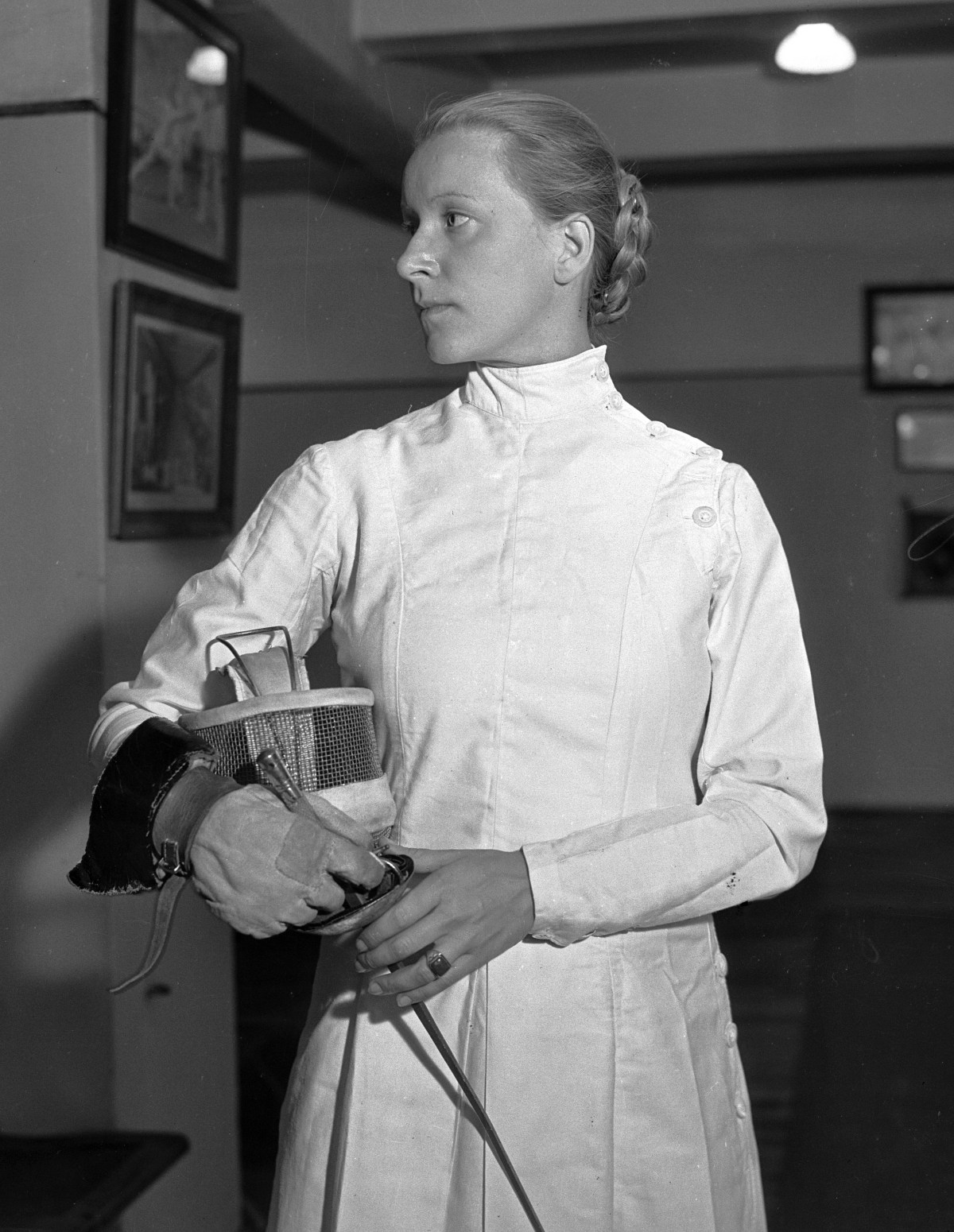
Helene Mayer, Olympic Fencer, c. 1936.
Helene Mayer, c1936” by Los Angeles Times is licensed under CC BY 4.0.

In episode 7 of this season, senior history major Keith Kuehn visits with Hollie about the 1936 Olympics in Berlin, or “The Nazi Olympics.” Helene Mayer (pictured above) was a German Jewish fencer who competed and won a silver for Germany. Keith unpacks the use of German propaganda, including film and television as well as the German discrimination against Jews and how this played out during the 1936 games.

Keith also briefly discusses his pet Eugene, who became the mascot for Ms. Marquess’s Women in American History course. Eugene, a female tortoise, got dressed up based on the theme of each week. Here she is as Eugene the Riveter.

Eugene Kuehn, tortoise extrordinaire

You can find this episode on Apple Podcasts, SpotifyAmazon Music, or any of the major podcast platforms. Make sure to subscribe so you never miss an episode. While you’re there, give us a review. Let us know what you like and share widely!

Selected Bibliography:

Birchall, Frederick T. “Goebbels Denies Intent to Use Games for Propaganda Purposes.” New York Times. July 31, 1936. accessed November 20, 2023. https://www.nytimes.com/1936/07/31/archives/goebbels-denies-intent-to-use-games-for-propaganda-purposes.html?searchResultPosition=20.

Kline, Christopher. “The Olympic Torch Relay’s Surprising Origins.” History. A&E Television Networks, published May 17, 2012. accessed December 2, 2023.

Pinkhasov, Seymon, dir. What If? The Helene Mayer Story. 2008; Hesse, Germany: 2021. stream. https://www.youtube.com/watch?v=ZIUs_ceGVYw.

Riefenstahl, Leni, dir. Olympia. April 20, 1938. https://www.youtube.com/watch?v=s23Q01qvdGs&t=1458s.

Riefenstahl, Leni. Leni Riefenstahl Interview, 1964. NDR-Nordschau. 1964. Accessed November 20, 2023. https://www.youtube.com/watch?v=L1zdzmxpif8&t=1s.

Are you interested in a history degree? We have online and on campus B.A. programs and we also have online and on campus M.A. programs in history or public history. Learn more at https://www.fhsu.edu/history/academic-program

Season 5 Episode 6- “Futball: A Voice for the Silenced in Nazi Germany” with David Solis

In episode 6, senior history major at FHSU, David Solis, joins Hollie Marquess to discuss the role of football (or soccer) in Nazi Germany. David explores the complex nature of resistance, both with individuals and whole soccer clubs, during the Nazi regime in World War II.

You can find this episode on Apple Podcasts, SpotifyAmazon Music, or any of the major podcast platforms. Make sure to subscribe so you never miss an episode. While you’re there, give us a review. Let us know what you like and share widely!

Selected Bibliography:

German Officials in Kiev. A flyer that advertised the rematch between Flakelf and FC Start. Summer 1942. From the DW, https://www.dw.com/en/death-match-in-the-shadow-of-war/a-16000159.

Arolsen Archives and Borussia Dortmund. Football Players in Focus: Educational Materials on Sports, Persecution, and Remembrance. Germany: Arolsen Archives, 2021. https://arolsen-archives.org/content/uploads/football-players-in-focus.pdf.

Simpson, Kevin E. Soccer Under the Swastika: Stories of Survival and Resistance during the Holocaust. Maryland: Roman & Littlefield, 2016. Accessed through ProQuest https://ebookcentral-proquest-com.ezproxy.fhsu.edu/lib/fhsu/reader.action?docID=4525022.

Are you interested in a history degree? We have online and on campus B.A. programs and we also have online and on campus M.A. programs in history or public history. We also have a new accelerated MA program. Learn more at https://www.fhsu.edu/history/academic-program

S5 E5- “Through Hell to the Midwest: Mapping Holocaust Survival in Kansas City” with Hollie Marquess, Amber Nickell, and Sarah Keiss

Midwest Center for Holocaust Education Monument in Kansas City

In this episode, Hollie Marquess is joined by Amber Nickell and Sarah Keiss. The three of them discuss their research project, “Through Hell to the Midwest,” which maps Holocaust survival using arcGIS and StoryMaps. Hollie, Amber, and Sarah discuss how they used oral history testimony from the Fortunoff Archives to trace Holocaust survivors from birth, through the Holocaust, and to their new lives in the Kansas City area. For more information on these survivors, visit:

You can find this episode on Apple Podcasts, SpotifyAmazon Music, or any of the major podcast platforms. Make sure to subscribe so you never miss an episode. While you’re there, give us a review. Let us know what you like and share widely!

Are you interested in a history degree? We have online and on campus B.A. programs and we also have online and on campus M.A. programs in history or public history. Learn more at https://www.fhsu.edu/history/academic-program

S5-E4 “Pauline Sabin and the Campaign Against Prohibition” with Whitney Befort

In this episode, junior history education major Whitney Befort joins Hollie Marquess to discuss Pauline Sabin and her efforts to repeal the 18th Amendment to the U.S. Constitution. Whitney covers her early life, her involvement in politics, and how she mobilized women all over the country to dismantle Prohibition in the U.S.

You can find this episode on Apple Podcasts, SpotifyAmazon Music, or any of the major podcast platforms. Make sure to subscribe so you never miss an episode. While you’re there, give us a review. Let us know what you like and share widely!

Selected Bibliography:

Sabin, Pauline Morton. “I Change My Mind on Prohibition.” Outlook, June 13, 1928. https://www.unz.com/print/Outlook-1928jun13-00254/.

“Women Will Battle For Dry Law Repeal.” The Atlanta Constitution (Atlanta, GA), March 1, 1932. https://archive.org/details/per_atlanta-constitution_1932-03-01_64_261/page/n13/mode/2up.

Ambrose, Hugh, and John Schuttler. Liberated Spirits: Two Women Who Battled Over Prohibition. New York: Berkely, 2018.

Neumann, Caryn E. “The End of Gender Solidarity: The History of the Women’s Organization for National Prohibition Reform in the United States, 1929-1933.” Journal of Women’s History 9, no. 2 (1997): 31-51. https://doi.org/10.1353/jowh.2010.0564.

“The Repeal of Prohibition.” Prohibition: An Interactive History. The Mob Museum. Accessed October 30, 2023. https://prohibition.themobmuseum.org/the-history/the-end-of-prohibition/repeal-of-prohibition/.

Are you interested in a history degree? We have online and on campus B.A. programs and we also have online and on campus M.A. programs in history or public history. Learn more at https://www.fhsu.edu/history/academic-program

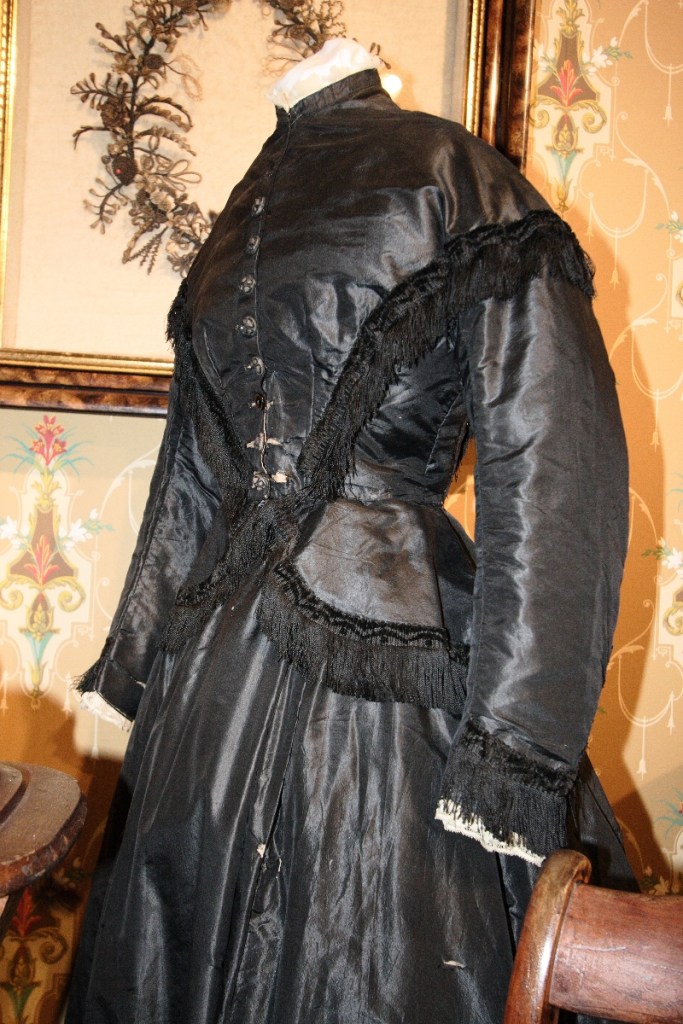
S5 Episode 3- “Women and Mourning Culture in the Victorian Era” with Kylah Smith

  “Mourning dress, 19th century” is licensed under CC BY-SA 2.5.

In episode Kylah Smith, junior history major, visits with Hollie about Victorian Era America’s mourning customs. She unpacks how mourning practices differed based on gender, social status, and relationship to the deceased.

You can find this episode on Apple Podcasts, SpotifyAmazon Music, or any of the major podcast platforms. Make sure to subscribe so you never miss an episode. While you’re there, give us a review. Let us know what you like and share widely!

Selected Bibliography:

“The Fashion of Mourning.” Godey’s Lady’s Book (March 1875).

“The Social Duty of a Woman: A Visit of Sympathy.” Cassell’s Family Magazine (1894).

McDaniel, Katherine. “Angels in Black: Victorian Women in Mourning.” City of Greeley Museums. Accessed November 5, 2023. https://greeleymuseums.com/victorian-women-in-mourning/.

Strange, Julie-Marie. “‘She Cried a Very Little’: Death, Grief and Mourning in Working-Class Culture, c. 1880-1914.” Social History 27, no. 2 (May 2002): 143–61.

Are you interested in a history degree? We have online and on campus B.A. programs and we also have online and on campus M.A. programs in history or public history. Learn more at https://www.fhsu.edu/history/academic-programs/   

S5 E2- “The German Genocide of the Herero” with Larry Zieammermann

History Grad student Larry Zieammermann joins Hollie to discuss the German Genocide of the Herero. If you haven’t already, pop back into season 1 to listen to his first appearance on the podcast when he discussed Lucy Parsons.

You can find this episode on Apple Podcasts, SpotifyAmazon Music, or any of the major podcast platforms. Make sure to subscribe so you never miss an episode. While you’re there, give us a review. Let us know what you like and share widely!

Selected Bibliography:

Gewald, Jan-Bart. Herero Heroes: A Socio-Political History of the Herero of Namibia 1890-1923. Athens, Ohio: Ohio University Press, 1999.

Gewald, Jan-Bart. “The Great General Of The Kaiser.” Botswana Notes and Records 26 (1994):67-76.

Schaller, Dominik J. and Zimmerer, Jurgen. “Settlers, Imperialism, Genocide: Seeing the Global without Ignoring the Local.” Journal of Genocide Research 10, no. 2 (2008): 191-99.

Erichsen, C.W.. “The Angel of Death has Descended Violently Among Them”: Concentration Camps and Prisoners-of-War in Namibia, 1908-1908. Leiden: African Studies Centre,2005.

Are you interested in a history degree? We have online and on campus B.A. programs and we also have online and on campus M.A. programs in history or public history. Learn more at https://www.fhsu.edu/history/academic-program

Season 5 Episode 5- “Kansas Methodists and the KKK” with Susan Elliott

In our first episode of the season, junior history major Susan Elliot joins Hollie to discuss the Ku Klux Klan in Kansas and its interaction with Kansas Methodists.

You can find this episode on Apple Podcasts, SpotifyAmazon Music, or any of the major podcast platforms. Make sure to subscribe so you never miss an episode. While you’re there, give us a review. Let us know what you like and share widely!

Selected Bibliography:

Baker, Kelly J. Gospel According to the Klan: the KKK’s Appeal to Protestant America, 1915- 1930. Lawrence, KS: University Press of Kansas, 2011.

“Kansas Ku Klux Donate $8160 to Wesley.” Wichita Sunday Eagle, November 19, 1922. https://kansashistoricalsociety.newspapers.com/image/64381053https://kansashistoricalsociety.newspapers.com/image/64381056.

“Ku Klux Klan Enters Kansas.” Emporia Gazette, July 23, 1921. https://kansashistoricalsociety.newspapers.com/image/16523569/?terms=%22ku%20klux %20klan%22&match=1.

“To the Lovers of Law and Order, Peace and Justice and to All Whom of Right It May Concern.” Evening Star, April 8, 1922. https://kansashistoricalsociety.newspapers.com/image/76634588/?terms=%22ku %20lux&match=1

Rives,Tim. The Ku Klux Klan in Kansas City, Kansas. Charleston, SC: History Press, 2019.

“Stinging Reply to Editor Who Criticized Klan Gift to Hospital is Hurled.” Evening Star, December 11, 1922. https://kansashistoricalsociety.newspapers.com/image/76632573/? terms=%22methodist%22&match=1.

Are you interested in a history degree? We have online and on campus B.A. programs and we also have online and on campus M.A. programs in history or public history. Learn more at https://www.fhsu.edu/history/academic-programs/         

Season 5 coming soon!

Season 5 premiers February 5th. Episodes come out every other Monday morning. This season’s topics include:

Kansas Methodists and the KKK

The German Genocide of the Herero

Women and Mourning Culture Fashion

Pauline Sabin and the Anti-Prohibition Fight

Mapping Kansas City Holocaust Survival

Soccer as a Voice for the Silenced in Germany

The Nazi Olympics

The Orphan Train

Mark your calendars and tune in February 5 to hear about Kansas Methodists and the KKK!

Season 4, Episode 7-  FHSU History Alumna Brianna Buller

Brianna Buller at Royal Holloway in London

In the final episode of Season 4, Hollie is joined by Brianna Buller. Brianna earned her B.A. in History at FHSU and went on to a M.A. in Public History at Royal Holloway in London. The two discuss her time at both universities, her Threads of Herstory Project, and adventures in Europe.

https://www.threadsofherstory.com/

You can find this episode on Apple Podcasts, SpotifyAmazon Music, or any of the major podcast platforms. Make sure to subscribe so you never miss an episode

Are you interested in a history degree? We have online and on campus B.A. programs and we also have online and on campus M.A. programs in history or public history. Learn more at https://www.fhsu.edu/history/academic-programs/